
Snehapana - Ghee Drinking
Before Cleansing Comes Preparation: Snehapana
Imagine trying to clean an old brass vessel.
You could scrape forcefully at everything stuck to its surface. Or you could first soften what has accumulated, loosen it gently, warm the vessel and only then begin cleaning.
The physicians of classical Ayurveda approached the body with a somewhat similar logic.
Before major Shodhana, the patient is usually prepared through Purvakarma. Depending upon the individual, this can include measures to support digestion, followed by Snehana, or oleation, and Swedana, therapeutic heat or fomentation.
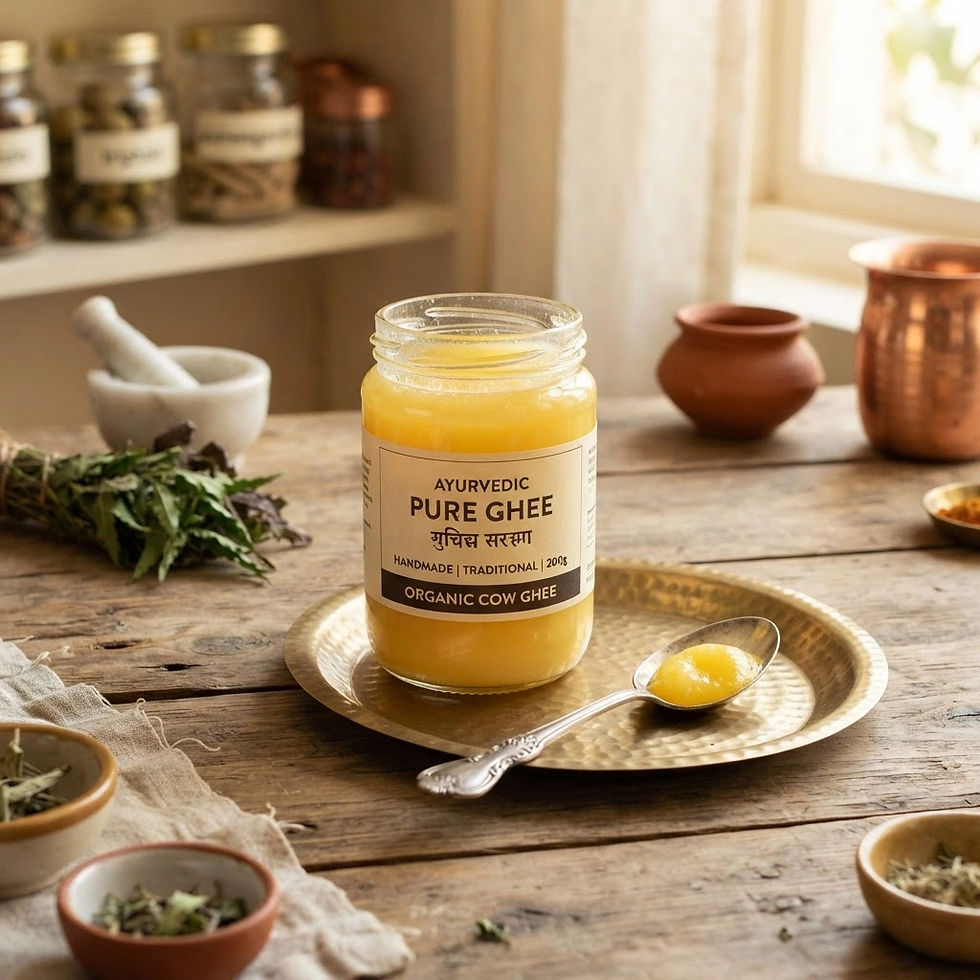
Snehapana means the internal administration of an unctuous substance—most commonly specially selected or medicated ghee, although classical Ayurveda describes several forms of Sneha.
Charaka devotes an entire chapter, Snehadhyaya in Sutra Sthana 13, to oleation. Near the end of the chapter comes a remarkably clear sequence:
First oleation.Then sudation.After adequate oleation and sudation, purification may be performed.
That order is explicitly stated in Charaka Samhita, Sutra Sthana 13.99.
Why give ghee before cleansing?
In Ayurvedic physiology, Snehapana is not simply "eating fat."
The quantity, substance, timing and number of days are selected according to factors such as agni—digestive capacity—koshtha, or bowel tendency, the patient's strength, constitution, disease and the purification procedure planned afterward.
Traditionally, Snehana is understood to produce softness and unctuousness and to help prepare aggravated doshas for their movement toward the gastrointestinal tract, where the appropriate Shodhana procedure can eliminate them.
Then Swedana—the controlled application of warmth—is used.
One can picture the classical intention as softening, mobilising and guiding before eliminating.
This is also why casually drinking large quantities of ghee at home is not equivalent to clinical Snehapana.
What has science studied?
A 2021 study in the Journal of Ayurveda and Integrative Medicine investigated escalating Snehapana with ghee in 29 healthy volunteers. Researchers measured body parameters and lipid profiles before and after the procedure.
Interestingly, total cholesterol, LDL and HDL did not significantly increase. Triglycerides and VLDL decreased in this small group, along with reductions in abdominal circumference and body weight.
That is intriguing, particularly because one might intuitively expect large quantities of ghee to worsen blood lipids.
But the study was small and lacked a conventional control group. It should therefore be considered preliminary physiological evidence, not proof that high-dose ghee is beneficial for everyone.
What it does demonstrate is something valuable: traditional procedures such as Snehapana can be studied using modern laboratory measurements rather than discussed only in philosophical language.
And once the preparation is complete, the physician chooses the appropriate route of cleansing.

Comments